By Daud zafar Minority turn into red
Introduction
Tehreek-e-Labbaik Pakistan (TLP) is not just a radical religious movement—it is an extremist organization that poses a direct threat to the survival and safety of Pakistan’s religious minorities. Operating under the guise of protecting the honor of Islam, TLP has, in practice, launched an ideological war against diversity, tolerance, and constitutional rights. This deep-dive blog post explores how TLP has systematically targeted minorities, weaponized blasphemy laws, and created a culture of fear and violence, pushing Pakistan toward religious apartheid.
TLP’s Anti-Minority Agenda and Extremist Ideology
TLP’s foundation is rooted in an exclusionary ideology that views non-Muslims—and even some Muslim sects—as threats. From its very inception, the organization has promoted:
Extremism in the name of religion
The marginalization and persecution of minorities
Violent street power as a political tool
According to data compiled by the Centre for Social Justice (CSJ), from 1987 to 2023, at least 2,120 people were accused under Pakistan’s blasphemy laws. Of these, a significant proportion were religious minorities, including Christians (16%), Ahmadis (38%), and Hindus (4%). TLP has been instrumental in inciting or leading many of these charges.
At least 85 individuals have been murdered in extrajudicial killings over blasphemy accusations. Several of these killings were carried out after or during TLP-led protests and campaigns.
Legal Framework and Manipulation of Blasphemy Laws
Blasphemy laws in Pakistan are found in the Pakistan Penal Code (PPC), particularly:
Section 295-B: Defiling the Holy Quran (life imprisonment)
Section 295-C: Use of derogatory remarks against the Prophet (death penalty)
These laws are frequently misused. According to Amnesty International, these provisions lack safeguards and are often used for “personal vendettas, property disputes, or to target minority communities.”
In recent years, the Prevention of Electronic Crimes Act (PECA) has expanded blasphemy surveillance into the digital realm, further endangering freedom of expression.
A Pattern of Violence, Intimidation, and Fear
TLP has normalized mob justice and vigilante killings. Their methodology often follows this pattern:
1. Blasphemy accusation—frequently fabricated or exaggerated.
2. Mass mobilization through mosque loudspeakers and social media.
3. Violent mobs attacking homes, churches, temples, or individuals.
4. Legal manipulation or failure to prosecute attackers.
This has led to a nation where minorities are afraid to speak, worship, or even exist openly. The Christian cross, Hindu temples, Ahmadi mosques, and even Shia religious practices are all seen as potential “provocations.”
Documented Cases of TLP’s Involvement or Influence
Asia Bibi Case (2018): After her acquittal, TLP launched nationwide riots, blocked major roads, and issued death threats to Supreme Court judges. The Christian community in Pakistan suffered severe backlash.

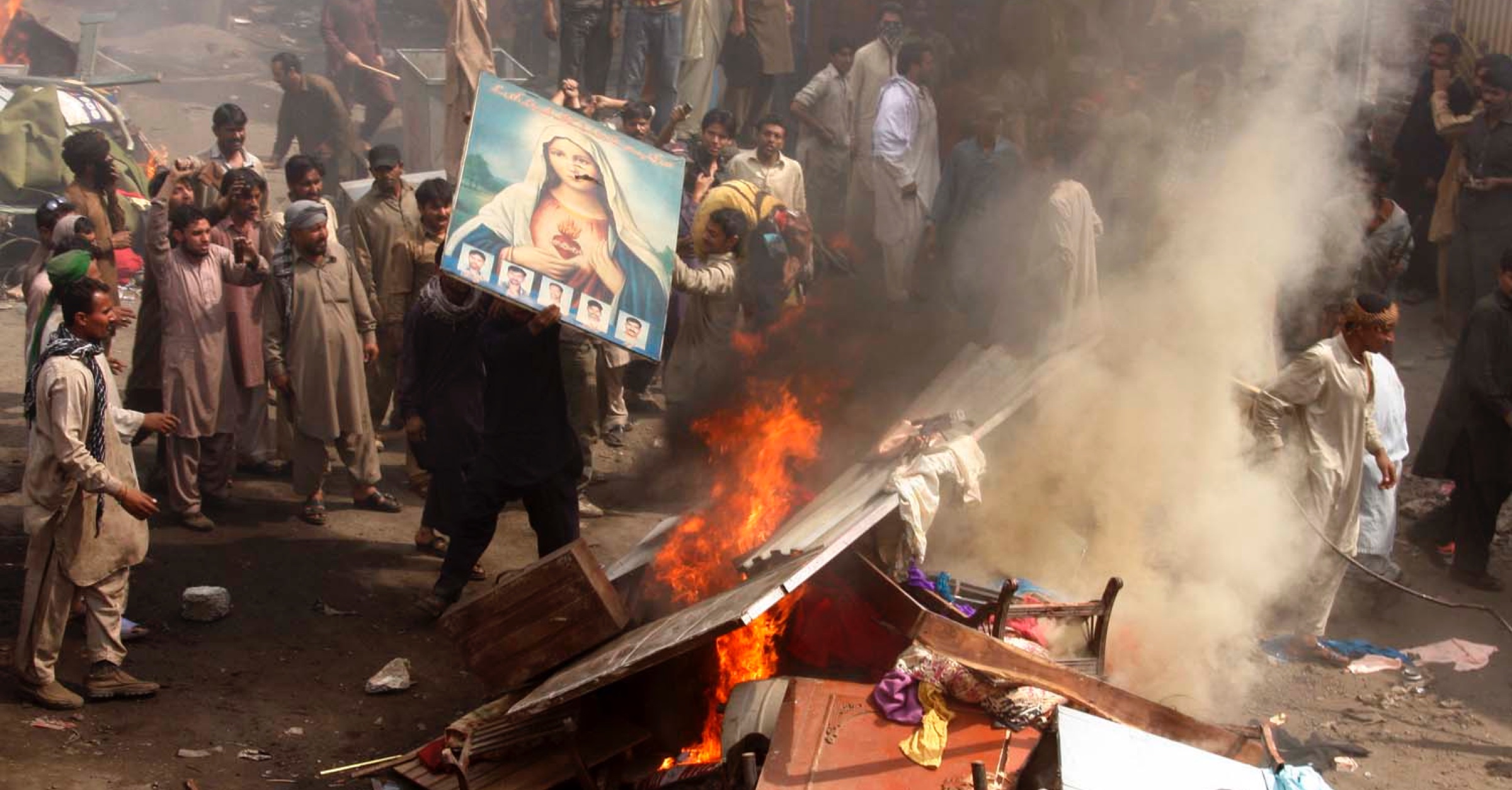
Jaranwala Church Arsons (August 2023): Mob attacks led to the burning of 26 churches and over 80 homes of Christians. Investigations revealed announcements were made in mosques affiliated with TLP sympathizers.
Sialkot Lynching of Priyantha Kumara (2021): Although no formal TLP members were charged, the slogans used by the mob mirrored those used in TLP rallies, and the crowd was radicalized through years of such narratives.

Nankana Sahib (2020): TLP supporters led a mob threatening to desecrate the birthplace of Guru Nanak. No action was taken against key provocateurs.
Prof. Khalid Hameed (2019): Killed by a student indoctrinated with extremist ideology. TLP rallies and speeches were identified as a source of radicalization.
Human Rights Organizations’ Response
Human Rights Commission of Pakistan (HRCP): Condemned the state’s failure to check “mob violence, incitement, and hate speech by TLP.”
United States Commission on International Religious Freedom (USCIRF): In its 2024 report, placed Pakistan as a “Country of Particular Concern,” citing TLP’s role in religiously-motivated violence and intimidation.
United Nations Human Rights Council (UNHRC): Urged Pakistan to repeal or amend blasphemy laws and ensure justice for victims of mob violence.
International Crisis Group: Warned in its 2023 briefing that “TLP poses a long-term risk to Pakistan’s democratic stability and social cohesion.”
TLP’s Political Aspirations: A National Crisis in the Making
TLP is now contesting elections and gaining parliamentary seats. If they gain broader power:
Blasphemy laws may become more punitive.
Dissenting voices (journalists, activists, minorities) could be silenced.
A theocratic state model could emerge, displacing Pakistan’s democratic and pluralistic foundation.
This would effectively turn Pakistan into a nation where religion becomes the tool of state oppression, and minorities become prisoners in their own land.
Pakistan Must Choose Between Fear and Freedom
Tehreek-e-Labbaik Pakistan is not merely a religious organization—it is an extremist movement that has weaponized religion to gain political control. Their actions have:
Encouraged mob killings.
Threatened national judges and institutions.
Terrorized Christian, Hindu, Ahmadi, and Shia communities.
Exploited legal frameworks to spread fear and violence.
The growing tolerance of such extremism threatens to erase the very identity of Pakistan as a multi-faith, democratic society. Unless countered, TLP may turn Pakistan into a theocratic state where the white in the flag—the minorities bleeds into red.
The time to act is now before fear becomes the law, and silence becomes the only language of the oppressed.
Regardless of which government is in power, whenever Tehreek-e-Labbaik (TLP) uses the blasphemy law as a weapon for their own agenda, they immediately become highly prioritized and pressurized by the authorities. Ironically, the state then tends to suppress the very minorities who are victimized by these tactics, while trying to manage or control the TLP threat. This creates a cycle where minorities bear the brunt of both extremist groups and government pressure alike.
Weaponization of Blasphemy: How TLP’s Pressure Tactics Target Pakistan’s Minorities and Force Governments into Submission
In Pakistan, regardless of which political party holds power be it civilian or military-backed the moment Tehreek-e-Labbaik Pakistan (TLP) invokes the blasphemy laws, the state apparatus begins to bend under pressure. TLP, a far-right Islamist group, has mastered the art of street agitation, using threats of nationwide protests, sit-ins, and mob violence to enforce its version of religious supremacy. Its weapon of choice is the highly controversial blasphemy law specifically Sections 295-A, 295-B, and 295-C of the Pakistan Penal Code.
Instead of challenging TLP’s narrative or protecting vulnerable citizens, the government whether under Imran Khan, Shahbaz Sharif, or military-installed setups often succumbs to fear. The police, judiciary, and even intelligence agencies are seen yielding to extremist demands, sometimes arresting alleged “blasphemers” (often minorities or political dissenters) with little to no investigation, just to prevent a violent backlash.
Between 1987 and 2021, over 2,120 people were accused under Pakistan’s blasphemy laws, and at least 89 individuals were murdered extrajudicially before trial. Many of these victims were Christians, Ahmadis, and Hindus, though Sunni Muslims too have been caught in the crossfire. In 2020 alone, 200 new blasphemy cases were filed—an exponential rise from previous years. These numbers surged again in 2024, with at least 475 cases, exposing the growing influence of ultra-religious vigilantism.
One of the most violent incidents occurred in August 2023, when TLP supporters torched 26 churches and dozens of Christian homes in Jaranwala, Faisalabad, after false accusations of desecration. Hundreds were displaced, and the state only responded after the international outcry.
In April 2025, a mob lynched an Ahmadi man in Karachi following a social media rumor. While the TLP denied formal involvement, their ideological rhetoric and years of public incitement directly contributed to the violence.
Even more disturbing are recent revelations (2024–2025) of a blasphemy entrapment network, allegedly backed by local clerics and corrupt officials, which ensnared over 450 Christians through manipulated WhatsApp messages and fake evidence. These “planted blasphemy” cases were used to seize property, silence human rights defenders, or extort money from vulnerable families.
In each of these cases, the state’s instinct was not to protect minorities, but to pacify TLP. This deference to religious extremism has made Pakistan’s minorities who make up less than 4% of the population essentially voiceless in the face of public mobs and institutional fear.
Sources and References:
1. USCIRF Report on Blasphemy Laws
https://www.uscirf.gov/sites/default/files/2023-12/2023%20Pakistan%20Blasphemy%20Issue%20Update.pdf
2. Human Rights Watch – Conspiracy to Grab Land (2025)
https://www.hrw.org/report/2025/06/09/conspiracy-grab-land/exploiting-pakistans-blasphemy-laws-blackmail-and-profit
3. Jaranwala Church Attacks (Wikipedia)
https://en.wikipedia.org/wiki/Jaranwala_church_arsons
4. Blasphemy Cases Statistics (HRWF Europe)
https://hrwf.eu/pakistan-statistics-about-victims-of-blasphemy-laws-1987-2021
5. Blasphemy Entrapment Scandal
https://www.thecitizen.co.tz/tanzania/news/international/opinion-blasphemy-as-a-weapon-how-pakistan-s-laws-persecute-minorities-5130338
6. AP News – Ahmadi Man Lynched in 2025
https://apnews.com/article/7fff778e05210f3b6e169518ffc7975d